
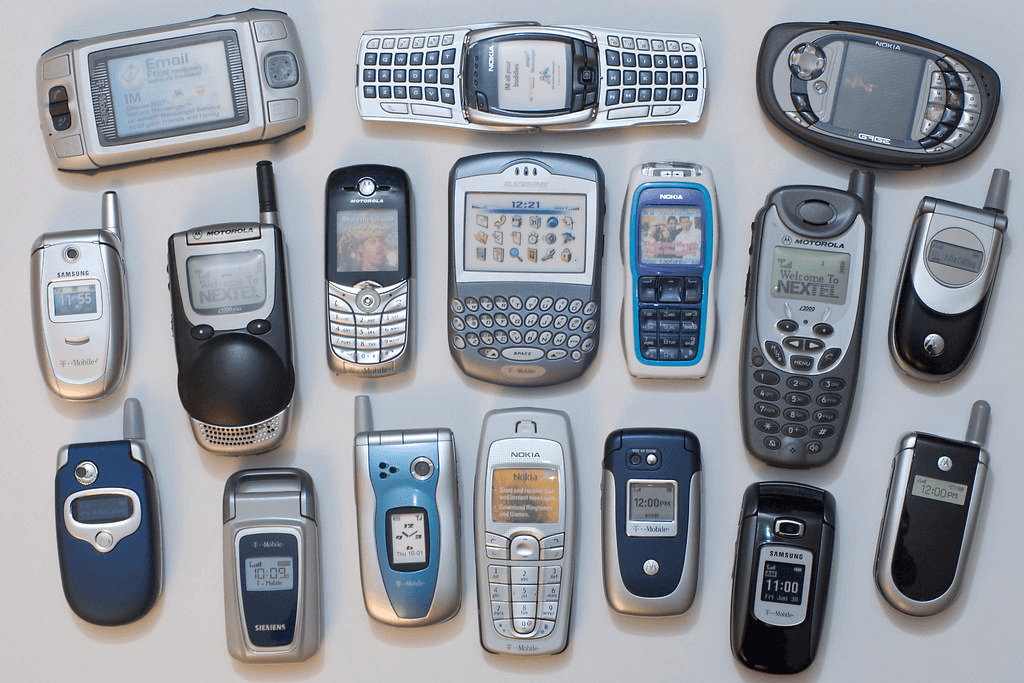
Lagos. It’s hot outside, the city is buzzing and you have somewhere to be. So you call a taxi and this is where it starts. You get to your destination, you pay by phone. The taxi driver will confirm your payment with his phone. The driver then uses his phone to transfer the money to his mother who lives in Abia. Across the continent, almost 4,000 km away in Nairobi, a mother comes home from work to realize they’re almost out of the bioethanol they need to cook dinner. So she heads to the KOKOpoint (cooking fuel ATM) to top up their bioethanol for the evening over the phone. All of this happened without an internet connection using hardware that costs less than $20.
Do you remember these?

If you do, that’s probably the last time you used USSD (Unstructured Supplementary Service Data). Activating the SIM card, checking the balance, recharging minutes, purchasing a ringtone, donating to charity – all this was done via USSD (not to be confused with SMS). A standard developed in the early 1990s as part of the GSM technical specification that allowed real-time, session-based communication between mobile devices and your mobile operators’ network services through simple menu-driven interfaces.
And if this all sounds foreign to you, here’s how it works at a high level. Someone with a working phone makes a request (something like this *123#), the message goes through their mobile network to a USSD gateway that routes the request to the appropriate application server based on a short code (that’s *123#). The server then responds in the same way with an offer for users to interact with. It’s a stateful session with fairly short timeouts. But it’s fast, cheap to run and only requires a 2G connection.

Then came internet-connected smartphones, and for many of us USSD fell out of favor with modern interfaces that more closely resembled our computer experience, eventually evolving into the first mobile designs we see today. Nothing probably shows this better than banking. (When was the last time you wrote a check?)
We move money so often, so quickly, and so easily, both from our traditional bank accounts and from digital wallets (Venmo, Cash, Zelle, Tikkie), that it’s hard to imagine anything else. Yet much of the world still lacks access to reliable internet or smartphones. In sub-Saharan Africa, mobile internet penetration is just 27%. However, they do have working phones; and lots of them.
Instead of access or hardware being the limiting factor, there are massively profitable businesses like M-Pesa, Moniepoint, Mukuru and OPay that have taken USSD, an old but ubiquitous messaging standard, and ingeniously turned it into a front-end for user transactions that rival the scale of their Western counterparts. M-Pesa alone processed over $100 billion in 2024, while Moniepoint processed 5.2 billion transactions worth $150 billion.
To be clear, these companies are not stuck in the past. They are building sophisticated cloud architectures behind these simple USSD interfaces. M-Pesa uses machine learning for real-time fraud detection while processing 4,000 transactions per second, with Safaricom using AWS for its cloud infrastructure. KOKO Networks operates what is described as Africa’s largest consumer fuel IoT deployment, with each of their more than 700 fuel stations connected to its cloud platform, sending real-time inventory data and enabling demand forecasting. This is not a story of technological limitations causing hardship. These are builders who are focused on technology that is suitable, not shiny.
“The limitations of materials are honesty in design. What you can’t do is as important as what you choose to do.” -Santiago Calatrava
While the ultimate goal of sub-$100 smartphones and universal connectivity is noble, it’s not today’s reality. 55% of mobile users in sub-Saharan Africa use 3G and it is estimated that a third of connections will still be 3G in 2030. There are hundreds of millions of people who can’t wait for technology to catch up with their daily needs. They need to buy groceries today, not tomorrow. They need to buy fuel this week, not at the end of the month. As long as this gap exists, builders who understand this urgency will constantly look for ways to bridge it with tools that actually work for their communities, and profit in the process. Although it’s not always obvious, it’s technology for the good.
Some final thoughts
Many of us have heard the acronym KISS, keep it simple stupid. A phrase that originated with the US Navy in the 1960s. Honestly, I don’t like it. Simplicity is hard. And you’re not stupid if you don’t succeed on the first try. However, I strongly believe that as builders we must relentlessly ask: are we really making things easy for our customers? Easy maintenance? Simple to update? Simple to explain?
Think of a car. It’s a complicated beast under the hood. A mix of mechanical and electronic components, sensors, computers, all working together.

But as a controller, the interface hasn’t changed much in nearly a century. A bike, some mirrors, a couple of pedals and a gear stick (clutch if you drive manual). You don’t need to understand fuel injection or anti-lock braking to get where you’re going. The same principle applies here. USSD may look primitive next to a smartphone app, but it works on every phone, requires no data plan, and your grandma can use it without step-by-step instructions.
Not everything has to be designed to the level of the Apollo 11 guidance computer. Sure, it’s the pinnacle of constraint-based design that uses a paltry 4KB of RAM to get astronauts safely to the moon and back. But that’s custom engineering for an extraordinary mission. The best engineering blends into the background of everyday life. You don’t think about driving your car or paying for groceries. No one writes headlines when someone sends money from Lagos to Kigali or uploads a file to S3. When technology works so well it’s practically invisible – that’s probably the best compliment you can get.
As builders, our job is to abstract away complexity and find elegant solutions to difficult problems. And when we do it right, it can be a beautiful thing. However, we must avoid the temptation to design for engineering and always work backwards from the needs of our customers.
This is why what is happening in sub-Saharan Africa is not only impressive in a regional context, it is a blueprint for building more resilient, efficient and cost-conscious systems anywhere in the world.
Now get building!